TYPES OF ARTIFICIAL INTELLIGENCE
Artificial Intelligence is really important for the world we live…
Artificial Intelligence is really important for the world we live in today. It is used in lots of things like smartphones and search engines to make them work better. Artificial Intelligence is also used in healthcare and online shopping to make things easier for people.
Many people do not really understand what Artificial Intelligence is. Simply put Artificial Intelligence is when computers can do things that people can do. This includes learning from data seeing patterns making decisions and solving problems.
Artificial Intelligence is not one thing. It is a field with many different types of systems that do different things. Understanding these types helps us see how Artificial Intelligence is used and what the future might hold.
In this article we will look at the types of Artificial Intelligence and how they are used in the real world.
So what is Artificial Intelligence?
Artificial Intelligence is when machines can think and learn like people. This is done using codes, data and computer power that lets machines look at information and make decisions.
For example when you ask a voice assistant to set an alarm or when an online store suggests products you might like Artificial Intelligence is working behind the scenes.
Over time Artificial Intelligence has gotten better. It used to follow simple rules but now it can learn and get better with experience.
Experts usually group Artificial Intelligence into types based on what it can do and how it works.
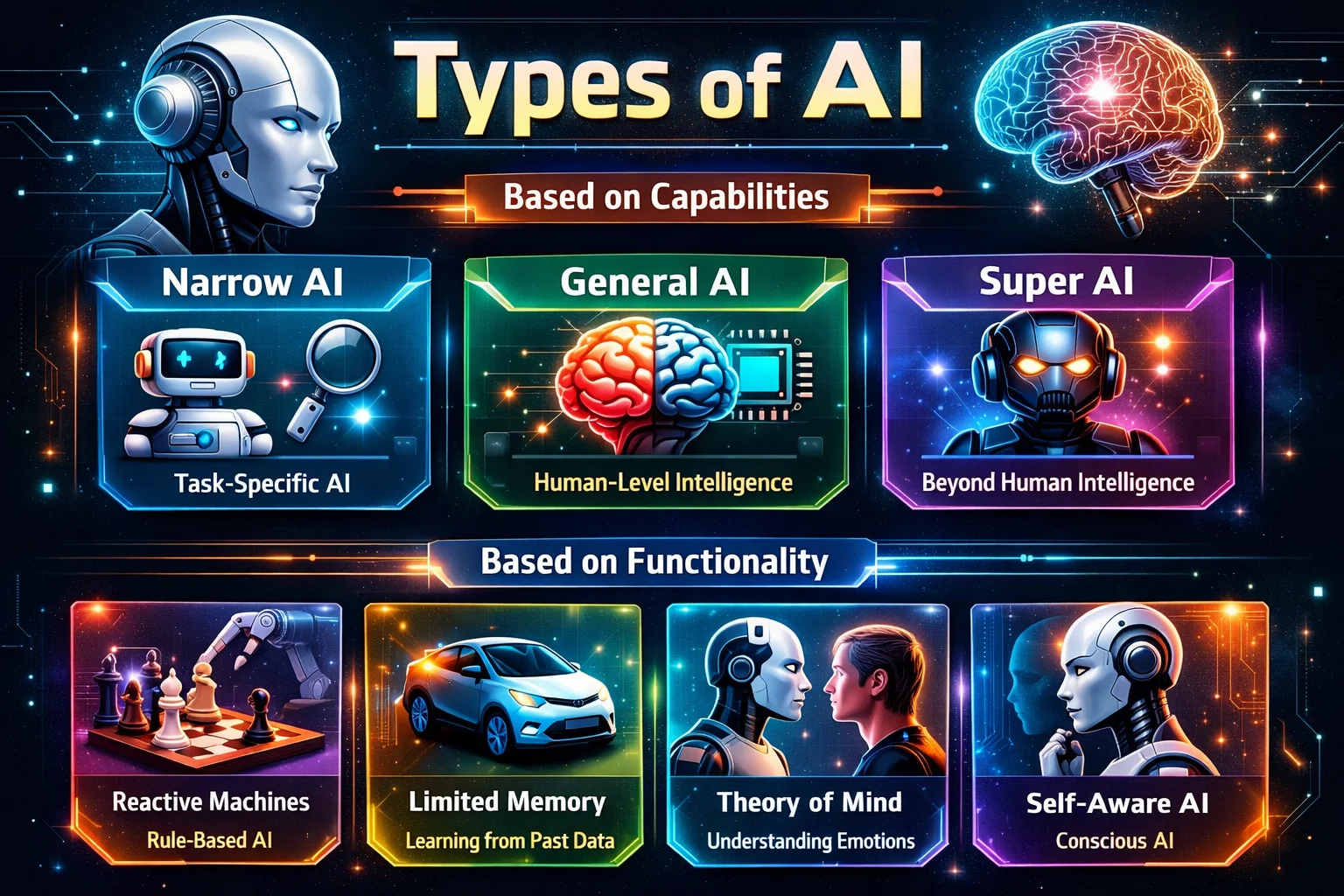
Types of Artificial Intelligence Based on What They Can Do
One way to look at Artificial Intelligence is to see how smart it is.
There are three types of Artificial Intelligence based on this.
1. Artificial Narrow Intelligence
Artificial Narrow Intelligence is the common type of Artificial Intelligence. It is designed to do one task.
This type of Artificial Intelligence can only do what it was made to do. It is really good at that one thing. It is not as smart as a person.
Most of the Artificial Intelligence people use every day is this type.
Examples of Artificial Narrow Intelligence include:
* Voice assistants like Siri or Alexa
* Chatbots that help customers
* Email spam filters
* Online recommendation systems
* Image and facial recognition software
For example when a video streaming platform suggests movies you might like it is using Artificial Narrow Intelligence. It looks at what you have watched and tries to guess what you might like next.
The good things about Artificial Narrow Intelligence are:
* It does tasks quickly and correctly
* It automates work
* It helps businesses be more productive
* It looks at a lot of data
Even though Artificial Narrow Intelligence is good at what it does it is not as smart as a person. Cannot think on its own.

2. Artificial General Intelligence
Artificial General Intelligence is an advanced type of Artificial Intelligence. It would be able to do anything a person can do.
Unlike Artificial Narrow Intelligence, which can only do one thing Artificial General Intelligence would be able to learn, understand things and adapt to situations.
For example Artificial General Intelligence could:
* Learn things without being programmed
* Understand language and context like a person
* Solve complex problems in areas
* Make decisions based on what it knows
now Artificial General Intelligence does not exist. Scientists are still trying to figure out how to make machines that’re this smart.
If we can make Artificial General Intelligence it could change a lot of things like healthcare, education and scientific research.
3. Artificial Super Intelligence
Artificial Super Intelligence is the advanced type of Artificial Intelligence. It would be smarter than people in every way.
It would not be as smart as people but would be better at things like being creative making decisions, understanding emotions and solving problems.
In theory Artificial Super Intelligence could:
* Solve complex global problems
* Make scientific discoveries
* Design technologies
* Improve itself without help
While this idea is really interesting it also raises questions about safety and control. Because of this many experts think it is important to develop Artificial Intelligence in a way.
Now Artificial Super Intelligence is just an idea that is talked about in research and science fiction.
Types of Artificial Intelligence Based on How They Work
Another way to group Artificial Intelligence is by how it works and interacts with the world.
There are four types based on this.
1. Reactive Machines
Reactive machines are the type of Artificial Intelligence. They respond to what’s happening but do not remember things or learn from the past.
They work based on rules. Look at the current situation to make the best decision.
For example the chess computer Deep Blue, made by IBM is a known example. In 1997 it beat the world chess champion by looking at millions of moves and choosing the best one.
However Deep Blue did not learn from games or get better over time. It just responded to the situation.
The main things about machines are:
* They do not have memory
* They cannot learn from the past
* They can only do tasks
Even with these limits reactive machines can be really powerful in certain situations.
2. Limited Memory Artificial Intelligence
Limited Memory Artificial Intelligence is more advanced than machines. It can use data to make better decisions.
Most modern Artificial Intelligence systems are this type.
They look at data see patterns and change their behavior based on what they learn.
Examples of Limited Memory Artificial Intelligence include:
* Self-driving cars
* Systems that detect fraud
* Recommendation algorithms
* Machine learning models
Self-driving cars are an example. They use sensors, cameras and past driving data to understand traffic and make decisions.
The good things about Limited Memory Artificial Intelligence are:
* It is more accurate
* It makes predictions
* It learns from data
* It is used in industries like finance, marketing, healthcare and transportation.
3. Theory of Mind Artificial Intelligence
Theory of Mind Artificial Intelligence refers to systems that can understand emotions what people want and how people interact with each other.
If this type of Artificial Intelligence is developed it could interact with people in a natural and smart way.
For example it could recognize emotions from expressions, tone of voice or body language.
Possible uses include:
* robots
* Advanced virtual assistants
* Tools to support health
* Systems that work with people
Although researchers are making progress Theory of Mind Artificial Intelligence is still being. Is not yet fully realized.
4. Self-Aware Artificial Intelligence
Self-Aware Artificial Intelligence is the advanced type of Artificial Intelligence. It would be aware of its existence and have feelings.
In theory a self-aware Artificial Intelligence system would be able to understand its thoughts and emotions.
Possible abilities include:
* Thinking
* Understanding itself
* Recognizing emotions
* reasoning
Right now Self-Aware Artificial Intelligence only exists as an idea and has not been developed.
Why Understanding Artificial Intelligence Types Matters
Learning about the types of Artificial Intelligence helps people understand how it works and where it is going.
Businesses use Artificial Intelligence to be more productive reduce costs and provide services. Researchers use it to solve problems and governments look at its role in policy and security.
Understanding Artificial Intelligence types also helps developers choose the technology for specific tasks.
For example a company making a chatbot for customer service might use Artificial Narrow Intelligence while a lab working on robots might look at ideas related to Artificial General Intelligence.
The Future of Artificial Intelligence
Artificial Intelligence is changing fast. Its impact on society will likely get bigger in the coming years.
Future developments might lead to:
* Better healthcare diagnostics
* Efficient transportation systems
* Improved climate modeling
* Advanced robots and automation
* Personalized education technologies
At the time discussions about Artificial Intelligence ethics, data privacy and responsible innovation are becoming more important.
Making sure Artificial Intelligence helps society while minimizing risks will be a challenge for researchers, businesses and policymakers.
Artificial Intelligence is changing the way people live, work and use technology. By understanding the types of Artificial Intelligence we get a better picture of how these systems work and how they might evolve.
From Artificial Narrow Intelligence that powers tools to the possibilities of Artificial General Intelligence and Artificial Super Intelligence each stage is a step towards more advanced intelligent machines.
As technology keeps advancing Artificial Intelligence will likely play a bigger role in shaping our digital world.
For businesses, developers and everyday users learning about Artificial Intelligence today is a step, towards preparing for the innovations of tomorrow.